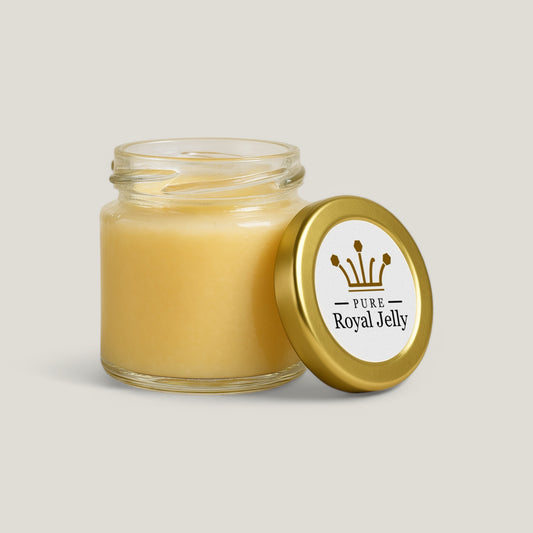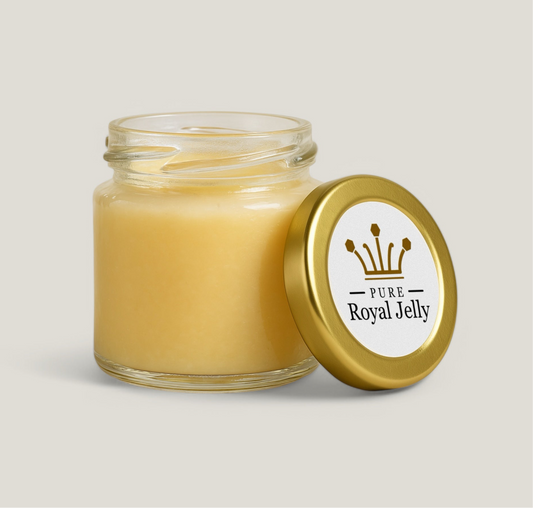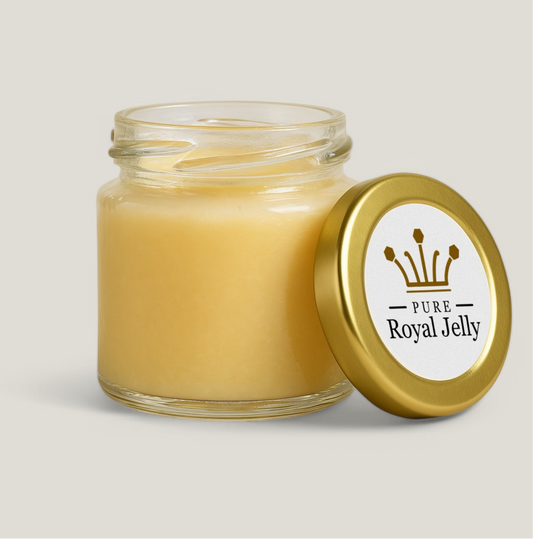
Fresh Royal Jelly vs Capsules: Which Is Better?
 Royal jelly comes in two very different forms: fresh (the thick, milky substance straight from the hive, kept chilled) and capsules or powder (freeze-dried and pressed into pills). If you’re trying to decide which to buy, the honest answer is that they’re not interchangeable - each has genuine strengths. This guide compares them fairly, using what the research actually shows, so you can choose the right one for you.
The Short Answer
Fresh royal jelly gives you the fullest, most complete nutritional profile and can be absorbed under the tongue, as long as it’s kept cold. Capsules are more convenient, shelf-stable and taste-free, but freeze-drying sacrifices some of the delicate compounds and rules out sublingual absorption. If potency and completeness are your priority and you’ll keep it refrigerated, choose fresh. If convenience and travel matter most, capsules make sense.
Here’s the detail behind that.

Fresh vs Capsules: At a Glance
| Fresh royal jelly | Capsules / powder | |
|---|---|---|
| Bioactive spectrum | Full — enzymes, volatile compounds intact | Good, but some compounds lost in processing |
| Absorb under the tongue | Yes | No |
| Fillers or binders | None | Often present |
| Taste | Tangy, acquired | Neutral (no taste) |
| Shelf life | Weeks–months, refrigerated | Long, shelf-stable |
| Needs refrigeration | Yes | No |
| Convenience / travel | Lower | Higher |
What Happens When Royal Jelly Becomes a Capsule
To make capsules or powder, fresh royal jelly is freeze-dried (lyophilised) — frozen, then placed under vacuum so the water turns straight from ice to vapour. This removes roughly 60% of its weight (the water) and leaves a concentrated powder that’s stable at room temperature.
Freeze-drying is actually a gentle process, and it preserves a lot: research reported in Drying Technology (Park et al., 2020) found optimised freeze-drying retains around 70–85% of royal jelly’s 10-HDA. But the losses aren’t evenly spread - they fall hardest on the volatile compounds, certain heat-sensitive proteins and enzymes, and acetylcholine (the neurotransmitter naturally present in fresh royal jelly). A 2020 comparative analysis published in Nutrients found that fresh royal jelly retained roughly 22% more bioactive compounds than freeze-dried forms overall.
In short: capsules keep most of the headline compound, but fresh keeps everything.
The 10-HDA Myth: Why Capsules Show a “Higher” Percentage
This one trips up a lot of buyers. You’ll often see capsules advertised with a 10-HDA content of 4–6%, while fresh royal jelly is usually around 2%, which makes it look like capsules are more potent. They’re not.
The difference is simply water. Fresh royal jelly is about 60–70% water, so its 10-HDA makes up ~2% of the whole substance. Freeze-drying removes that water, concentrating everything that’s left - so the same 10-HDA now represents a larger percentage of a smaller, drier mass. Gram for gram of actual royal jelly solids, the two are comparable. A higher 10-HDA percentage doesn’t mean freeze-dried is superior, only that its moisture has been removed.
So don’t be swayed by a big number on a capsule label. It’s a concentration effect, not extra potency.
Where Fresh Royal Jelly Wins
- The complete bioactive spectrum. Fresh keeps the volatile compounds, acetylcholine, active enzymes and full protein profile that processing can diminish.
- Sublingual absorption. Only fresh royal jelly can be held under the tongue, letting some compounds absorb directly into the bloodstream and bypass stomach acid. You can’t do that with a capsule.
- No fillers or binders. Fresh is 100% royal jelly — no anti-caking agents, flow agents or capsule shells.
- Closest to its natural state. Minimal processing means what the bees made is what you get.
Where Capsules Genuinely Win
It’s only fair to give capsules their due — for some people they’re the better choice:
- Convenience and travel. No spoon, no fridge, no mess — just swallow a pill. Ideal for busy routines or time away from home.
- Shelf-stability. Freeze-dried powder is far more robust at room temperature. A 2025 review in Foods notes that freeze-dried royal jelly can maintain its antioxidant and antibacterial activity for extended periods at room temperature.
- No taste. Fresh royal jelly is tangy and slightly bitter; capsules sidestep that entirely.
- Precise, consistent dosing. Each capsule delivers a measured amount, with no guessing.
The Honest Catch With Fresh: It Has to Be Kept Cold
Here’s the part many “fresh is best” articles leave out. Fresh royal jelly’s advantage depends entirely on how it’s handled. Kept properly chilled at around 2–5°C, fresh royal jelly is remarkably stable, research reported in the Journal of Apicultural Research (Sabatini et al., 2009) found it can retain up to 97% of its 10-HDA over six months refrigerated.
But left at room temperature, fresh royal jelly degrades quickly, measurable protein breakdown can occur within about two weeks (Balkanska et al., 2017, Food Chemistry). That’s the trade-off: fresh offers the fullest potency, but only if the cold chain is respected from hive to fridge. Poorly stored fresh royal jelly can actually end up less potent than a well-made capsule.
This is exactly why sourcing matters, buying fresh royal jelly that’s been kept cold and delivered chilled, then storing it in your fridge, is what preserves the advantage you’re paying for.
So Which Should You Choose?
Choose fresh royal jelly if you want the fullest bioactive spectrum, you’d like to take it under the tongue, you don’t mind the tangy taste, and you’re happy to keep it refrigerated. This is the option for getting the most from royal jelly.
Choose capsules if convenience is your priority — you travel often, won’t reliably keep it cold, prefer no taste, or want the simplicity of a measured pill. A good capsule still delivers real value.
For most people taking royal jelly at home for its full benefits, fresh is the better choice — provided it’s stored correctly.
How to Get the Most From Fresh Royal Jelly
To preserve everything that makes fresh worth it: take it in the morning on an empty stomach, hold it under your tongue to dissolve, keep it in the fridge, and never stir it into hot drinks (heat degrades its delicate compounds). For the full routine, see our guide on when to take royal jelly.

A Note on Safety
Royal jelly is a food supplement, not a medicine. It shouldn’t be taken by children, or by women who are pregnant or breastfeeding, and it should be avoided by anyone allergic to bees, bee pollen or bee products. If you take any medication or have a health condition, check with your GP first, and stop use if you notice any adverse reaction.
Frequently Asked Questions
Is fresh royal jelly better than capsules?
For overall potency and completeness, yes — fresh retains the full bioactive spectrum and can be taken under the tongue. But it must be kept refrigerated. Capsules are better for convenience, travel and shelf-life.
Does freeze-dried royal jelly have more 10-HDA than fresh?
It shows a higher percentage (typically 4–6% vs ~2%), but only because freeze-drying removes the water and concentrates everything. Gram for gram of solids, they’re comparable — the higher number doesn’t mean more potency per dose.
What does freeze-drying remove from royal jelly?
It keeps most of the 10-HDA (around 70–85%), but volatile compounds, acetylcholine and some heat-sensitive enzymes and proteins are reduced. Fresh keeps these intact.
Do royal jelly capsules contain fillers?
Often, yes: binders, flow agents and the capsule shell itself. Fresh royal jelly is 100% royal jelly with nothing added.
How should I store fresh royal jelly?
Keep it refrigerated at around 2–5°C, or freeze it for longer storage. Kept cold it stays potent for months; left at room temperature it degrades within weeks.
Are royal jelly capsules a waste of money?
Not at all — a well-made capsule still delivers real value and is more practical for many people. Fresh simply offers a more complete profile if you’ll store it properly.
The Bottom Line
Fresh royal jelly and capsules both have a place, but they’re built for different priorities. Fresh delivers the fullest bioactive spectrum and sublingual absorption, the closest thing to royal jelly as the bees made it, provided you keep it cold. Capsules trade a little of that completeness for genuine convenience and shelf-stability. If you want to get the most from royal jelly and you’ll keep it refrigerated, fresh is the better choice.
At Pure Royal Jelly, our priority is to offer the most potent royal jelly with the most benefits, and that’s why we only sell fresh. If you’d like to try it, explore our range of fresh, chilled-delivered royal jelly.
Disclaimer: The information on this page does not constitute medical advice. Royal jelly is a food supplement and is not intended to diagnose, treat, cure or prevent any disease. It must not be used by children, or by women who are pregnant or breastfeeding. Avoid it if you are allergic to bees, bee pollen or bee products, and consult your doctor before use if you take any medication or have a health condition. Do not exceed the stated dose, and discontinue use if any adverse reaction occurs.
Sources
- Park M.J. et al. (2020) freeze-drying and 10-HDA retention in royal jelly, Drying Technology.
- Comparative analysis of bioactive compounds in fresh vs freeze-dried royal jelly (2020), Nutrients.
- Sabatini A.G. et al. (2009) 10-HDA and quality/stability of royal jelly, Journal of Apicultural Research.
- Balkanska R. et al. (2017) storage and protein stability of royal jelly, Food Chemistry.
- Monitoring and Maintaining the Freshness of Royal Jelly: A Review of Analytical Approaches and Preservation Technologies (2025), Foods: pmc.ncbi.nlm.nih.gov
- Collazo N. et al. Royal Jelly: Biological Action and Health Benefits (composition; 10-HDA, MRJPs), PMC: pmc.ncbi.nlm.nih.gov